Submissions from Readers
Speech Therapy and Stroke Questions
Determining the Type of Aphasia
Question Hello, my dear friend had a stroke a year ago last December. Unfortunately her husband and she had fallen upon severe financial distress before the stroke, so her medical resources were very limited at the time and only now do they have state assistance which does not cover any type of therapy.Her husband and I would like to start some form of home speech therapy, but after reading about the different types of aphasia there are, we are now more confused about where to start. How does an untrained professional evaluate where to start with home speech therapy? Can it even be done?
My dear friend seems to understand what you are saying but only utters one word over and over again in response - Lola. Her left side is inactive, she is in a wheel chair but does tend to her own personal hygiene to a certain extent. With no medical assistance, we are striving to do something to help her regain some of her speech or at least improve her communication skills and some form of independence. Is there such a thing as cost-free speech therapy?
Thank you
Cary Asuncion
Answer: Here are some ideas for you
1)Search to see if there are any speech clinical trials in the area in which she could participate. See www.stroke-rehab.com/stroke-clinical-trials.html for more information on clinical trials.
2)See if there are any schools in the area that offer speech language pathology degrees. You could contact the school and see if they ever use patients for training or know of someone such as a continuing education provider that does. All therapists must complete continuing education credits to keep their license and some continuing education providers use actual patients during their courses to provide training.
3) Contact the American Speech-Language-Hearing Association (if you are not in the US, then contact your country's association), and ask for any information or resources that they may have.
4)Find websites and books that offer information about speech therapy. You could go to your local library and look for books about aphasia and treatment of aphasia or order books off of amazon.com. You can also search for websites that offer information on aphasia exercises. One such website is theadultspeechtherapyworkbook.com
It sounds as if your friend has problems with expressive language since she cannot verbalize what she wants to say. If she cannot follow directions, she may have trouble with receptive language as well. Some stroke victims have difficulty with both. You would want to look up exercises for expressive aphasia based on what you've told me, but if your friend has problems with understanding and following directions then you would want to do exercises for receptive aphasia as well.
I know you stated that their financial resources are limited, but if they can afford it, it would be beneficial to go for one speech therapy evaluation and determine the weaknesses as well as have the therapist issue some home exercises. If your friend is able to do one visit, make sure her husband explains their situation ahead of time so the therapist can gather exercises and be prepared to issue a home exercise program. Hopefully, I've given you some ideas and resources to help!
Cognitive Impairment After a Stroke.
by Sandra
(PA)
Question:My 60 year old brother had a stroke that has affected his right side. He is experiencing an inability to recognize the written word but can speak and communicate fine. He can watch a half hour sit-com and follow the story but show him a written sentence and he cannot process the words. Will this improve with therapy - and what kind of therapy will help?
Answer: This problem is identified as alexia, and he needs to see a speech therapist. I have seen this happen after stroke. It should improve with therapy, but I don't know to what extent. I have seen some people improve greatly and others continue to have problems. Here is an article that you may find helpful:
https://www.ncbi.nlm.nih.gov/books/NBK557669/.
Speech Problems, Mild Lazy Tongue
Question: Can a caregiver contribute to speech exercises? I am a music therapist and have voice exercises which might help like tongue twisters and tonal/speech sequences to loosen the tongue and jaw to help with articulation.
For my loved one, mostly the guttural consonants are affected and the sibilants:
For example saying "glue" is difficult
Sphinx - combining tip of tongue and x-k-g guttural and P/B -T/S/Z -L -R - BRBRBR
Also pursing of lips is affected with a slight inability to drink with pursed lips from a paper cup with lid and small opening (like a paper coffee mug)!
HE loves the nonsense - rhymes and Spike Milligan poems. Any other suggestions?
Answer: Caregivers can absolutely help with speech therapy exercises. Improving articulation after a stroke requires specific speech therapy exercises tailored to the individual's needs though, so you should check with a speech therapist to make sure the exercises are right for your loved one. Examples of exercises that speech therapists use to improve articulation include:
Tongue Exercises:
Tongue push-ups: Press the tongue against a flat the roof of the mouth to strengthen tongue muscles.
Tongue lateralization: Move the tongue from side to side inside the mouth, touching each corner.
Lip Exercises:
Lip puckering: Practice pursing the lips as if giving a kiss.
Lip stretching: Stretch the lips wide, as if smiling, and hold the position.
Jaw Exercises:
Jaw sliding: Slide the jaw side to side or forward and backward.
Jaw opening and closing: Gently open and close the jaw to increase mobility.
Articulation Drills:
Repeating sounds: Practice saying specific sounds or words repeatedly to strengthen articulation.
Minimal pairs: Work on words that differ by only one sound to improve accuracy (e.g., "cat" and "bat").
Tongue Twisters:
Recite tongue twisters that target specific speech sounds or sound sequences.
Blowing Exercises:
Blow bubbles, a pinwheel, or a straw to enhance oral muscle control.
Specific Sound Practice:
Focus on practicing specific sounds that are difficult for the individual.
Sentence Exercises:
Read sentences aloud, emphasizing clear articulation of target sounds.
Practice producing different sentence structures containing the target sound.
Functional Conversation:
Engage in structured conversations, working on using clear speech and appropriate articulation in real-life situations.
It's important to note that exercises should be guided by a licensed speech therapist who can tailor the therapy to the individual's specific needs. Visit this Adult Speech Therapy website for more information on exercises to improve articulation and speech difficulty.
Speech Therapy After Stroke
by David
(Alabama)
Question: Is it normal for speech to be good at one point during the day and then be bad later?
Answer: It is not unusual for speech to deteriorate in a stroke victim during the evening or after they have been up for a while. Just as arm and leg muscles become fatigued so does mouth musculature which can cause speech to become more distorted and difficult to understand later in the day. There can also be mental fatigue which can result in increased speech difficulty. One other factor to look at is medication. Medication could be affecting speech patterns so it is important to recognize if symptoms appear after taking medicine.
Speech Therapy Aids
by Anita
(Lake, WV)
Question:My mother had a hemorrhagic stroke 1 year ago. She lost her speech and is also paralyzed on her right side. We no longer have therapists to aid us in her recovery. What can I do to help her regain her speech. She occasionally says simple words like, no, yeah, oh lord, or oh god. She has learned to make her needs known in other ways but there are still times when we don't have a clue about what she wants or needs. It is very frustrating for us and her.
Answer: I recommend making or purchasing a communication board with pictures. The pictures would entail her most frequent requests (food, drink, bathroom, pain, etc.) I would search for the phrase "communication board for stroke patient" on one of the search engines for ideas or to find a communication board you can purchase. There are ones out there that are very detailed if your mother is able to point to the pictures. If she is not, then you might work on learning to use a communication board with her.
You can also visit theadultspeechtherapyworkbook.com/ website referenced in above questions. You might consider telehealth services for speech therapy. Telehealth is where therapy services are delivered over a computer connection between the therapist and patient, so it's a nice option for doing therapy at home.
Speech Problems
by Gene Pester
(Woodland Hills, CA USA)
Question: I had a stroke 4 years ago. I have had problems while talking to anyone. It seems that my thoughts don't always get transmitted to my mouth. I kind of stutter before I can get it out. This problem is not continuous and may be associated with subjects. I find it most difficult when talking about something and I need to remember something about the subject. Once I get passed the event, I can talk normally.
It is not debilitating, but it is frustrating and seems to be getting worse.
Also, immediately after my stroke, my eye sight changed. I wear glasses for near sightedness. After my stroke I could see better without my glasses. I changed my prescription to accommodate my new eyes, but the condition changes over time. It almost seems eyes change hour to hour. If I squint, I can see better, but it hurts when I do that. I work on the PC a lot and it is difficult to work since my eyes go in and out of focus.
Any ideas?
Gene Pester
Answer: You would benefit from getting a speech therapy evaluation/consult and get some exercise recommendations to improve your memory/word finding. You could try some online games that help with memory and word finding. One such site is https://www.improvememory.org/brain-games/word-games/.
As far as your vision issues, I would visit a neuro-ophthalmologist or neuro-optometrist that deals with vision problems after stroke. Since your focusing goes in and out, I wonder if you might be having problems with the eyes tracking simultaneously. You might be able to test this by covering one eye and reading then trying it with the other eye. If you don't notice the same problem as when both eyes are open then you may have a problem of the eyes not working together. A neuro eye doctor could help identify exactly what problem you are having and could refer you to a vision rehabilitation specialist.
Comments for Speech Problems
|
||
|
||
Speech
by Dennis Haut
(Bettendorf, IA)
Question: I had Posterior Occipital Stroke December 23, 2013. I am home from hospital now. Sometimes I can't find words. Here is my important question: My speech is halting and slow most times but some times is close to normal. Is this normal for it to come and go?
Answer:This is a very common complaint from stroke patients. Often speech and/or the ability to find words will fluctuate post stroke. Some of the obvious factors that will affect speech are fatigue (physical and mental), frustration, being tired or sleepy, new situations, and medications to name a few. The good news is that you are very early in the recovery process, and this is the time when the most rapid gains in recovery are made. Hopefully this fluctuation in speech will be less noticeable to you or be resolved altogether as you continue to heal from your stroke.
Aphasia
by Ramon Guardado
(Rogers, AR U.S.A.)
:Question: I had a stroke 7 years ago and I'm having problems in communicating. My speech is terrible and I'm looking for some exercising to do online to improve my speech.
Answer: You can review these resources:
https://www.stroke-rehab.com/aphasia.html
http://www.aphasia.org/category/i-have-aphasia/
http://csuspeechandhearingclinic.weebly.com
You also might look into local universities to see if they offer free speech therapy provided by their students who are training to be speech language pathologists. Here is a link describing the speech and language clinic at the University of Arkansas in Fayetteville:
http://http://cdis.uark.edu/speech-hearing-clinic/
Speech Therapy in Mother Tongue
by Erazuna
(Bdnoni South Africa)
Question: My brother is afrikaans speaking; yet most of his speech therapy is in English. Does that not effect the recovery of speech negatively?
Answer: In my opinion, his speech therapy should be done in his first language rather than English unless he is quite proficient in English. Sometimes when people have strokes, they will revert to speaking in their first language especially if it is more comfortable for them.
Speech Therapy
by catherine gutterson
(bordentown nj)
Question:My father had a stroke 2 weeks ago. He is currently in a rehab center and is making progress, but he is hating the place with a passion because of the speech therapy portion that is making him frustrated and feel humiliated. He is feeling hopeless and depressed which he shouldn't because he is doing well with the other 2 therapies, physical and occupational, thank our lucky stars. He's not interested in eating and no longer smiles when you enter the room. He just wants to come home, and he is mixing his days up and saying things that just didn't happen as if he's hallucinating. Can speech therapy be given at home? I believe the stoke hurt him cognitively. Is that something that can be overcome at home with time. I want to blame the environment and not being home because he has always been independent at 83 and up and on the go, and this is keeping him bored and restless especially at night, He's a bad boy for the nurses. Your insight and help is greatly appreciated.
Answer: Speech therapy as well as the other two therapies can be given at home. Your dad may do better at home in familiar and comfortable surroundings, but taking him home does not necessarily mean his cognition will improve. Only time will tell. Cognitive changes may be a result of the stroke, but these changes can also occur because of medicines or lack of sleep. Sometimes, elderly patients that have dementia, even if just a slight dementia, will become more confused when removed from their home and put in a new situation. I can't tell you whether your father will do better at home or not, but you definitely can have home health therapists come to see him. The only disadvantage to home health this early in his stroke recovery is that they only come out 2 or 3 times a week usually for 30-45 minutes. In an inpatient rehabilitation facility, patients will be seen several hours per day at least 5 days a week. Inpatient rehabilitation usually only lasts a few weeks for stroke patients so I would try to take advantage of the more frequent/intense therapy as long as possible.
Stroke Aphasia
by Denise Lehman
(Pleasant Valley, MO)
Question: If you had a mid-cerebral artery stroke, does aphasia get worse and also what is the most amount of time you have seen the "light" come back on after someone has suffered this type of stroke? Thanks.
Answer: The mid-cerebral artery can be affected in different areas as well as the left versus the right MCA. The severity of damage as well as the effects and long term outcomes vary among stroke victims, so it would be difficult to predict what happens. The MD working with the patient may be able to give you some idea of prognosis based on severity and area of the MCA involved. Generally, the longer someone continues with adverse effects (especially more severe effects), the more difficult it will be for recovery. In my practice, I find that the most rapid recovery occurs in the first six months after stroke and slows down after this time period. Many gains can still be made after this initial period, but in my experience they are slower to occur and not usually as significant as the initial gains made.
I would recommend doing a search on "aphasia outcomes after stroke" which will give you a lot more information.
Aphasia but Intelligent
by JB
(Texas)
Question:My mom, 73, had a both kinds of stroke almost 2 years ago resulting in right side paralysis, some apraxia, and aphasia. She went from working full time as a secretary to a hospital bed. After suffering gall bladder attacks, PEG tube placement, Cdiff, a fall, and a broken hip, she has finally come around to being fairly healthy but living in a nursing home close to me.
Throughout all of this her communication has not improved. She has about 10 words she repeats for everything. We've told her she doesn't make sense. She has a communication tablet to use, but she never uses it. Yet, she continually tries to talk to us and expects us to understand her. There are times through the long minutes of charades, we can get what she's talking about to a point, but many times, after LONG periods of trying, we just give up. I feel we have failed her by humoring her at times pretending to understand or going through the charades or not insisting that she try to use the device.
She can write and sometimes get the letter or part of word but it is taxing and a chore. Aside from all of that, she still has a very intelligent mind, but because of right side paralysis and the communication issue, she has no way of expressing her thoughts or of doing anything really productive. So she sits in a nursing home in a wheelchair. Her aides and nurses have mostly learned her needs and gestures but this is not communicating and does not help when she wants to have these lengthy, abstract conversations with me or her roommates or others in the home. She also calls and rattles on for an hour, and I have almost no idea of what she's talking about.
How can I help her realize she doesn't make sense? How can I help her use her device or be more clear? Do I continue to humor her? We are all tired of living in frustration but I do not know what else to do. Any advice would be helpful.
Answer: Rehabilitation for speech often requires a long term strategy, and I highly recommend that you get more speech therapy for your mom. If they do not offer speech therapy at the nursing home or you are not impressed with their speech therapy services, you can hire an outside therapist to come in on a private pay basis. I would check to see what services the nursing home has regarding speech therapy and support groups.
If there is limited help, and you cannot afford to pay for ongoing private services, you can have a speech therapist come out for just one or two visits and then meet with your family and the hospital staff to discuss strategies to help your mom.
I'm not sure if your mom is capable to leave the nursing home to attend outside appointments, but you could also search for external services that could benefit her. I don't know what area of Texas you live in, but for example, in the Dallas area, there are several free programs for patients with aphasia. A speech therapist in your area would most likely be able to tell you what services are available.
If none of the above is an option, you could read online about treatment for Wernicke's aphasia and speech apraxia for suggestions. I highly recommend using the services of a speech therapist though over trying to figure it out yourself.
Deterioration in Speech 10 Months Post Stroke
Question: My husband had a major hemorrhagic stroke 10 months ago. His right side was paralyzed and he lost speech and his swallowing ability. He made good recovery in the first 3 months and was able to start swallowing. Some speech returned, and he started walking with help. Now 10 months later I feel his speech is starting to deteriorate. Before he could converse with others in broken speech, and others could understand what he was trying to say. Now he has severe difficulty in recalling words and is unable to carry on a conversation. Even I can no longer understand what he is trying to say. Can you please offer some advice about what I should do to help him? Thank you.
Answer: I would recommend evaluation by a MD to see if there have been changes in the brain or a subsequent stroke since it sounds like he has had a significant change in status. If no new neurological issues are found, I would recommend returning to speech therapy to address the new problems he is experiencing.
Word Recall
by Julie Carlson
(Lake Orion, Michigan)
Question: My mom had a small stroke last fall, and it affected her word recall, especially under stress. Her conversation is normal, but she cannot recall some words. For example, she can draw a fork, and she can point to a fork, but if you ask her what the object is, she cannot say fork. She also has poor short term memory and has a hard time remembering her phone number, the city she lives in, etc.
She is done with speech therapy, and she seems to have stalled on her rehab. She is often frustrated, and we'd like to help her. What kinds of exercises or games would help her?
Answer: I would see about getting her a tablet and using some of the many aphasia apps. Here is a website that lists various aphasia apps: https://www.aphasiasoftwarefinder.org/app-software-list.
Any devices to recommend for communication
by Mike
(Houston, tx)
Question:My father-in-law had a major stroke 19 years ago. He has basically lost speech. He is an amazingly intelligent person, reads still nonstop but cannot communicate but a vocabulary of 15 -20 words.
He stopped therapy about 15 years ago. Just wondering if there are any tools as far as apps that are available now for him? He is still an avid reader but cannot get the words or spelling out. I am looking for a way for him to get out what ge is trying to say. Any help would be appreciated
Answer: There are many aphasia apps now on the market. Here is a webpage that lists various aphasia apps and how they work: https://www.aphasiasoftwarefinder.org/app-software-list. Read through the descriptions, and you should be able to find one that will assist your father-in-law. Many apps allow for a free trial as well.
communication following stroke
Question: Hi my father suffered with a small stroke 1 year ago followed by a few Tia's. The stroke mainly affected his speech and cognitive thought . He has recovered, but occasionally when he is tired or is woken up abruptly he becomes confused and appears to be word finding this always wears off usually 30 mins to 1 hour later. Can this be permanent, and will he just have to learn to now accept this as normal. Thank you
Answer: This could be permanent, and I see it frequently. It is not unusual for someone who has had a stroke to struggle with symptoms when tired or waking up from sleep especially with language and cognition.
speech setback
Question: My friend had a stroke a few months back and has been doing great. At the beginning, she had a terrible time talking. With nonstop speech therapy, she has been making incredible progress. However, she woke up a couple of days ago and her speech had regressed. It is not as bad as right after the stroke but definitely not as good as she has been. She has no other symptoms of setbacks. I'm trying to support her in the best way I can as she has been getting depressed with the setback. My question is how come she had a setback? I have looked everywhere but without luck.
Answer: She should be checked out to make sure she did not have another stroke or TIA. You can have a stroke with the only symptom being speech issues. I have had several patients report they regress with their speech. I do not know of any reason why this would happen. Hopefully it may just be a fluctuation in speech performance rather than a digression. It would not be unusual to have days that are not as good as others. I'm sorry that I do not have more information for you.
Semi-paralysis of mouth muscles
by Norma Lopez
(Austin, Texas)
Question: What can an elderly eat after having a stroke that semi-paralyzed his left mouth muscles?
Answer: I recommend having an evaluation by a speech language pathologist (speech therapist). The speech therapist can then let you know in what ways his diet can be modified and what is safe (and unsafe) to eat. The therapist can also suggest exercises to help. If he had an evaluation in the hospital, but you did not receive this specific information, I would still go for another evaluation where you are present and can ask questions.
Comprehension/intelligence/correct wording when speaking
by Vickie Johns
(Columbia, sC)
Question: My ex-boyfriend had a major stroke about 14 months. When he had the stroke he laid there for over 8 hours before he was found and sent to the hp. This man has pretty much rehabbed himself. He got the basic rehab for kinda talking, walking, etc. but he is way more advanced then this. his brain has rewired itself and he is wanting to get to the point to where when speaking he is using the correct words. Instead of saying 15 for 5 he wants to say 5 for 5. Understand? He does have seizures, last one was about 3 months ago. He has started to try jogging around a track, he at lest makes one round a day, he tries practicing on his drums (he was once the best). He wants to call people by their correct names, right now he isn't able to say my name, Vickie.) He wants to be retrained above more then what he has received and these rehab centers here act like they don't know what to do for him. He is able to drive and he does drive. He keeps his 5 yr old daughter every weekend and usually at night through the week. He's getting more and more angry about the whole thing and isn't being given the correct rehab to improve himself.
What and where can he go to get the advanced training he needs in and around Columbia, SC?
Answer: He might check with the University of South Carolina Arnold School of Public Health. They have a speech and hearing research center. There are research studies/treatment as well as aphasia support groups whose focus is to work on communicating with others/having conversation with each other. You can visit their webpage here. Here is a link to their brochure for participation in aphasia research (participation is free): https://web.asph.sc.edu/aphasia/wp-content/uploads/2016/04/USC-Aphasia-Lab-Brochure.pdf.
Comments for Comprehension/intelligence/correct wording when speaking
|
||
|
||
Memory problem and finding hard to read
by Samantha Mcniven
(Lanark Scotland)
Question: I'm a 34 year old woman. At the start, I thought I was fine with memory and I'm now noticing that my memory is starting to deteriorate. I'm constantly repeating my self asking the same things.I'm constantly always getting my children to repeat or do things as well. Although I've had physiotherapy for my hand and still doing so I still have numbness and pins and needles. Also at the start I couldn't write that great almost like a 3yr old. I'm getting there but I get all shaky and some pain on my writing fingers. Is any else I can do apart from physio? It's so frustrating and I feel bad for my family as most women my age with kids are fit and healthy and now I can only maybe read a book or just sit and watch them play. Oh and another thing since the stroke my energy levels have dropped dramatically is this also common?
Answer: It is common to be fatigued after stroke. It is important to make sure you get adequate sleep at night, rest after you've been up a while and start feeling fatigued, and to get some type of aerobic exercise. If you have trouble with balance or impact activities, then think of activities that you can do that still allow you to get the aerobic benefit (such as a recumbent stationary bike or maybe water aerobics). Many people do not get enough exercise and feel tired. This is true of people who have had strokes and even the general population. It is easy to get in a rut. One must form a habit (usually takes at least 30 days to form a habit) of regular exercise to reap the benefits of energy that come along with it. The recommended aerobic exercise amount is 30 minutes/day for 5x/week. It can be done in short spurts if you can't do 30 minutes straight and increase the time as you are able. If you are taking medications, check to make sure that side effects are not fatigue. Sometimes meds need to be re-evaluated. Don't be hard on yourself, and don't compare yourself to others. Take a little time to do short spurts of activity with your kids, and know that they will appreciate any time/activity with you regardless if it's different than what another mom might be doing. Try to readjust your thinking and enjoy the small accomplishments. Smaller accomplishments will eventually lead to larger accomplishments.
READING Problem
by Sukanya
(Kolkata)
Question: My husband is suffering from a stroke since last year. His right vision is affected, and he can't read anything but recognizes the type and the alphabet. Kindly help.
Answer: Since he recognizes the type and alphabet, the problem he has may be due to alexia rather than vision. When the left side of the brain is damaged, it is common for language abilities to suffer since most language functions occur in the left hemisphere. Alexia is a disturbance in reading due to brain damage and can be assessed by a speech pathologist. If you have access, I would suggest a consultation with a speech therapist to determine if the problem is alexia. Sometimes people don't have access to therapy services or can't afford treatment, but it can be worth it to at least get an evaluation and some recommendations for home exercises. Let the therapist know ahead of time if the patient can't come for multiple visits, and ask for a home exercise program.
I'm not sure what the patient's native language is, but there are phone apps and websites that have exercises as well to help with alexia. I know the English version of these apps, so feel free to e-mail info@stroke-rehab.com if you'd like the English versions. Otherwise, you'll need to search the apps or websites in your own country to find ones that are in a different language.
Comments for READING Problem
|
||
|
||
Aphasia and employability
by Linda R McCall
(New Orleans, LA, USA)
Question: My daughter had a massive stroke almost 14 years ago at age 28. She has rehabilitated extremely well but struggles with aphasia. She would very much like to work but employment is very limited for someone with aphasia. Are there resources to get her back into he work force. She is starting to get depressed. She was extremely talented and successful prior to her stroke. As she says, everything is still inside her head but it is difficult to get it out correctly when speaking or writing. I would like to find resources for her to build her self esteem and sense of self worth back up. Any ideas or recommendations would be most appreciated.
Answer: Each state has vocational rehabilitation services to help people with rehabilitation and return to work force. You indicate you are in Louisiana, so you can visit https://www.laworks.net/WorkforceDev/LRS/LRS_Rehabilitation.asp online to get more info. If your daughter happens to live in a different state, you can find each state's information regarding vocational rehab at https://www.stroke.org/en/life-after-stroke/recovery/return-to-work/state-vocational-rehab-agencies. She can also connect with others via the National Aphasia Association where professional with aphasia have a biweekly video chat for those with aphasia working or wanting to return to work. Visit https://www.aphasia.org/stories/professionals-with-aphasia-share-the-ups-and-downs-of-the-workplace/ for more info. There are probably many other resources on the National Aphasia website as well.
Speech getting worse 2 weeks after stroke.
by Cara
(Ohio)
:Question: My mom had a mild left side ischemic stroke about 2 weeks ago. She has small deficits with the dexterity in her right hand and right leg, but was able to walk and still use the right hand. Her speech wasn't affected too much, a little slurring on the 1st day, then some forgetting of words, but she could still talk like a normal person, it was just slow. Yesterday my sister called because because now she can barely talk. She just says one or two words, can't form full sentences and is tripping over easy words. Is it common for speech to get worse, especially when it wasn't affected to begin with?
Answer: I would check with her MD as sudden changes could indicate new events. Stroke patients are at a higher risk for having another stroke. Also, stroke patients can have seizures following stroke, so I would follow up with the MD if there are sudden changes not related to fatigue or being ill. It is not uncommon for changes to occur because someone is tired or sick. If you notice that your mother is better earlier in the day and fades later in the afternoon or is worse when she doesn't get enough sleep, this would indicate she is just fatigued. Also, if a stroke patient has an illness (e.g. UTI, respiratory virus), they may not function as well.
Treatment Tips from Others
To see tips from other survivors and caregivers about their treatment recommendations, click here.
Get Our Stroke Rehab Guide

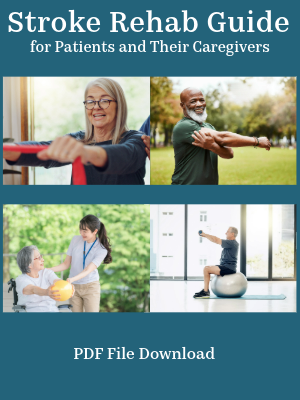
Our stroke rehab guide is designed specifically for patients and caregivers. It's in pdf format and can be immediately downloaded. It includes about
- Stroke Definition & Causes
- Stroke Treatment
- Rehabilitation Information for Physical, Occupational and Speech Therapy
- Exercise pictures
- Q&A from patients and caregivers
- Adaptive Equipment & Techniques
- How to Prevent Another Stroke & More!
Medical Disclaimer: All information on this website is for informational purposes only. This website does not provide medical advice or treatment. Always seek the advice of your physician or other healthcare provider before undertaking a new healthcare or exercise regimen. Never disregard professional medical advice or delay seeking medical treatment because of something you have read on this website. See the disclaimer page for full information.
- Home
- Stroke Questions
- Speech getting worse 2 weeks after stroke.
Recent Articles


-
Stroke Recovery Tips Back Issues from Stroke Rehab Website
 View past issues of Stroke Recovery Tips Newsletter to learn unique information about stroke rehabilitation.
 -
Gift Ideas for Stroke Patients for Recovery, Comfort & More
 Top gift ideas for stroke patients and stroke recovery and rehabilitation.
 -
Jerking Movement After Stroke
Question: Why is there a sudden jerk on the paralyzed/flaccid side of a stroke patient? Is it normal or not? Answer: Here are a few of the reasons stroke -
Hand Exercises for Stroke by Certified Hand Therapist
 Hand exercises for the stroke patient that will improve fine motor skills.
 -
Stroke and High Blood Pressure
 The silent killer - understand how stroke and high blood pressure are related.
 -
Are Strokes Hereditary? Understanding Your Risk Factors
 The Question: Are Strokes Hereditary? The Answer: Genetics can play a significant role in determining one's risk.
 -
What is apraxia caused by a stroke and how to treat it
 What is apraxia and it's various forms that occur after stroke including speech, ideational, and ideomotor apraxia.
 -
Caregiver Questions and Issues
Questions and answers from Stroke Caregivers