Neuroplasticity Exercises for Stroke Recovery
You can ask many different experts, and neuroplasticity will be explained in many different ways. In stroke recovery, neuroplasticity basically refers to the ability of the brain to rewire or reorganize itself after injury. Neuroplasticity exercises for stroke recovery require task repetition.
Medically reviewed by Karen Murray, OTR, CHT, CSRS
Neuroplasticity Explained
Can the Brain Rewire Itself?
Various studies over the past decade have shown that the adult brain can "rewire" itself when damaged, creating new neurons, a phenomenon called neurogenesis. These new neurons require support from neighboring cells, blood supply, and connection with other neurons to survive. During rehabilitation, task repetition and task specific practice is needed for neurogenesis and plasticity to change the brain. Hundreds of repetitions per day and thousands over time are needed for these changes according to various research studies.
Neuroplasticity in Rehabilitation
Since neuroplasticity principles require repetition of task and task specific practice to be effective, the stroke patient should incorporate these techniques in their daily lives. What this means for the stroke patient is that going to see your therapist for a one hour visit (or even a 3 hour visit) is not enough to lead to neuroplastic changes in the brain. Patients need to think of physical, occupational, and speech therapy as an adjunct to stroke recovery. It's up to the patient to make the most of recovery by continuously using the injured parts of the body and mind outside of therapy sessions in everyday life.
A good comparison would be how one learns multiplication. A teacher doesn't just show a multiplication table a couple of times to her students for the concept to be mastered. Instead, students have to practice over and over to learn and master multiplication. A child doesn't learn how to walk overnight. It requires much practice. A baseball player doesn't become elite just by playing a few games of baseball. You must take control of your stroke recovery process and be willing to invest a lot of time and energy if you want to see change especially with moderate to severe stroke. It's also important to keep using a skill once you have mastered it - use it or lose it as you often hear in rehab.
Neuroplasticity Exercises: Does Practice Make Perfect?
Please note that plasticity doesn't mean that one can practice every task over and over and accomplish them all. Stroke is much more complicated than that. Different parts of the brain control different body functions and the brain adapts better to some areas of damage more than others. Scientists have identified certain areas of the brain that yield neurogenesis but have not identified it in all areas of the brain.
If you want to learn more about your specific stroke, ask your neurologist specifically what areas of your brain were affected. The neurologist will also be able to tell you what problems you can expect because of that damage (e.g. speech deficits, vision deficits, dizziness, difficulties with balance, etc.) You can further improve your rehabilitation by specifically targeting the weaknesses caused by your stroke.
What Type of Therapy is Used to Promote Neuroplastic Changes After Stroke?
Neuroplasticity principles doesn't necessarily require you to change the type of exercises and therapeutic activities done in stroke rehabilitation but rather emphasizes that more repetition and task specific practice is needed. Probably the most commonly used therapy that is based on neuroplasticity is constraint induced movement therapy (CIMT). CIMT involves limiting the movement of the non-affected or stronger arm and instead using the affected or weaker arm more frequently and intensely.
There has been some positive research results with CIMT, however, it requires much effort and patience from the stroke patient. Some other treatments that may help with brain reorganization include interactive metronome, brain retraining software and websites, mirror box therapy, and robotic and gait devices that assist with movement repetition.
Research is still needed in the area of brain plasticity and stroke rehabilitation. Scientists have demonstrated that brain reorganization can occur and rehab treatments have been developed in attempt to promote neuroplasticity. The stroke patient, armed with the knowledge that brain rewiring occurs with repetition, can improve their rehabilitation outcomes by application of this concept in their daily lives. Remember, therapy is an adjunct to recovery. You cannot go to therapy sessions and expect positive outcomes without applying what you have learned on a consistent daily basis.
How the Brain Reorganizes Itself with Neuroplasticity Exercises
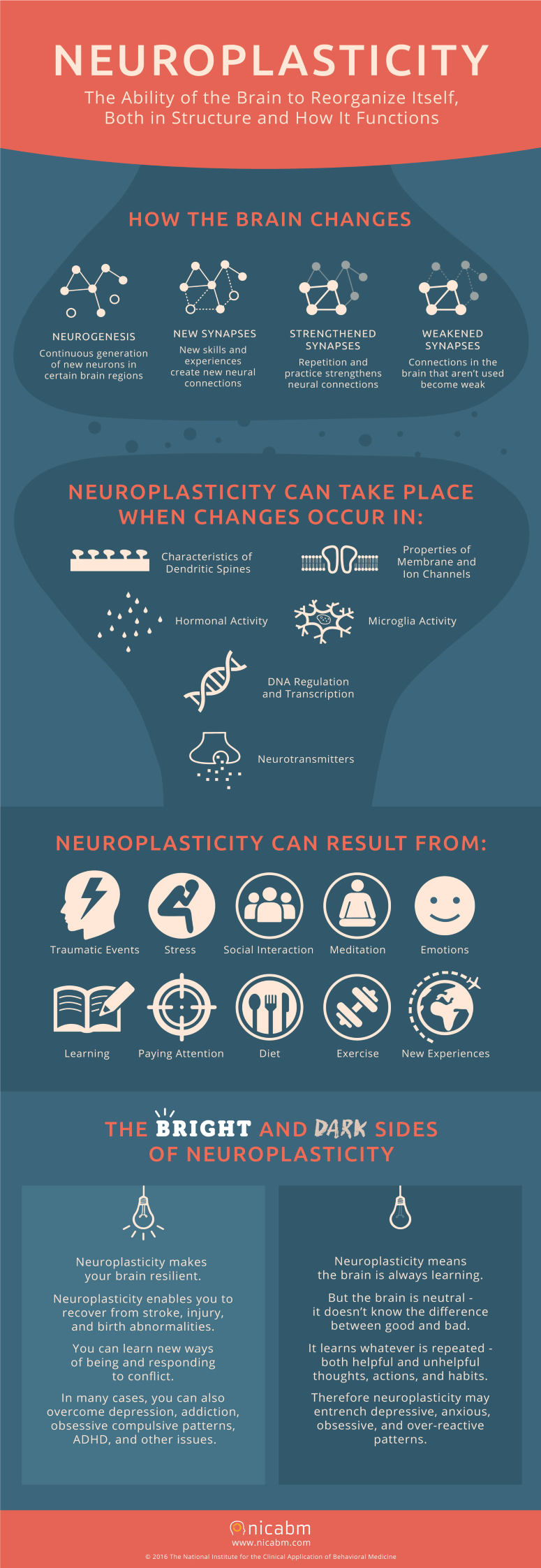
Here is a useful infographic on neuroplasticity from NICABM:
Neuroplasticity: Key Takeaways
Due to brain neuroplasticity, the possibility of improvement — even years after a stroke — is very real. With persistence and repetitive practice, many people continue to make progress. Therapy at a facility a few times per week is not sufficient in making the neuroplastic changes needed, so stroke patients must practice tasks and exercises at home on a daily and regular basis.
If the affected extremities are ignored, this will trigger "learned nonuse". When a stroke patient relies solely on their working side, the brain treats the neglected, affected limb as unnecessary causing the brain to reduce the neural representation area assigned to that limb. This results in a change of the brain's body map, worsening function in the affected extremities.
Lastly, it is important to remember that neuroplasticity has limits. The brain may not always reroute certain kinds of damage, and not all functions can be regained. Research continues to learn more.
FAQs about Neuroplasticity Exercises
What are examples of arm neuroplasticity exercises?
- Towel Slides: Place your affected hand on a towel on a smooth table. Actively try to push the towel away from you and pull it back.
- The Cup Slide: Place a plastic cup on a table. If you cannot grasp it yet, use the side of your arm or the back of your hand to actively slide the cup across the table.
What are examples of leg neuroplasticity exercises?
- Seated Kicks: While sitting, have someone place a target in front of your affected foot. Actively try to kick the target.
- Object Clearing: While seated, place a small object (like a book) on the floor. Actively lift your leg up, move it over the object to the other side, and then back. This mimics the movement needed to get in and out of a car.
Are there neuroplasticity exercises for speech or cognitive issues?
- The Alphabet Word Game: Start with the letter A and name one object you can see or think of. Move through the alphabet to force the brain to search and retrieve vocabulary.
- Puzzles and Games: Work on jigsaw puzzles or card-matching games to force the brain to process visual shapes and logic.
More Info on Neuroplasticity Exercises
Our Stroke Rehab PDF Guide has been developed to help stroke patients perform stroke recovery exercises at homes and has a section dedicated to neuroplasticity, CIMT, and task ideas to help with neuroplastic changes in the brain.
Get Our Stroke Rehab Guide
Our comprehensive stroke rehab guide in pdf format is designed for both patients and caregivers who want clear, practical ways to support recovery, improve daily function, and regain independence at home. It includes
- Rehab exercises with pictures for safe home practice
- Physical, occupational, and speech therapy guidance
- Tips for daily activities and adaptive equipment
- Answers to common questions from patient and caregivers
- Information on stroke causes, treatment, and prevention
A single therapy visit can run $150 or more. The Stroke Rehab Guide is only $14.99, and includes a pdf guide you can continue to refer to in the future with exercises and information on stroke recovery. In addition, any time an update or new version of the guide is written, you will get the updated version for free.
About the Author
Karen Murray, OTR, CHT, CSRS, is a licensed occupational therapist, Certified Stroke Rehabilitation Specialist, Certified Hand Therapist, and Certified Personal Trainer with over 29 years of experience working with stroke survivors in hospital, outpatient, and home settings. She founded Stroke-Rehab.com to help patients and caregivers better understand stroke recovery, find evidence-based resources, and regain independence at home.
Medical Disclaimer: All information on this website is for informational purposes only. This website does not provide medical advice or treatment. Always seek the advice of your physician or other healthcare provider before undertaking a new healthcare or exercise regimen. Never disregard professional medical advice or delay seeking medical treatment because of something you have read on this website. See the disclaimer page for full information.
- Home
- Neuroplasticity
Recent Articles


-
Are Strokes Hereditary? 8 Genetic Risk Factors to Know (2026 Guide)
 Is stroke risk in your DNA? Are strokes hereditary? Learn 8 genetic factors to watch for and how to protect yourself.
 -
Home Exercise Equipment For Stroke Patients. Rehab at Home.
 Continue your stroke rehab at home with your own home exercise equipment. Examples of inexpensive exercise equipment for home use.
 -
Balance Exercises for Stroke Patients: Prevent Falls!
 Pictures of balance exercises in sitting and standing to help stroke patients.
 -
Flaccid Paralysis Treatment After Stroke: Questions & Answers
 Answers to questions about flaccid paralysis treatment after stroke including home exercises and treatment ideas.
 -
Leg and Foot Problems After Stroke
 Answers to stroke patients' questions regarding foot and leg problems after stroke
 -
What is a Good Gift for a Stroke Patient: Gift Giving Guide
Gifts for Every Stage of Stroke Recovery: From practical aids to inspiring keepsakes, find the perfect present for your loved one. -
Stroke Recovery Tips Back Issues from Stroke Rehab Website
 View past issues of Stroke Recovery Tips Newsletter to learn unique information about stroke rehabilitation.
 -
Gift Ideas for Stroke Patients for Recovery, Comfort & More
Top gift ideas for stroke patients and stroke recovery and rehabilitation. -
Jerking Movement After Stroke
Question: Why is there a sudden jerk on the paralyzed/flaccid side of a stroke patient? Is it normal or not? Answer: Here are a few of the reasons stroke -
Hand Exercises for Stroke by Certified Hand Therapist
 Hand exercises for the stroke patient that will improve fine motor skills.




Sign Up For Our Newsletter

Newsletter Sign Up
Receive Stroke Recovery Tips, our online quarterly newsletter. Sign up below for free tips on exercises, resources, latest technology, apps, research and more!
To view past issues of Stroke Recovery Tips, visit https://www.stroke-rehab.com/Stroke-Recovery-Tips-BackIssues.html