by CHRISTY
Question: What is the treatment protocol for flaccid stage of stroke? How long does this flaccid stage usually remain?
Answer: There is no set amount of time that the flaccid stage remains. For some it can resolve in days, others weeks or months. Most stroke patients I see don't remain flaccid and do gain some amount of tone which can range anywhere from minimal to severe.
During the flaccid stage, it is important to keep the arm supported and positioned well. Retrograde massage can be used to help with hand/forearm edema (unless massage is contraindicated due to CHF or similar diagnosis). You can use pillows or a tray to help support the weak arm. Slings are an option, but I don't personally like slings because they immobilize the arm and often cause poor positioning and alignment. If I do use a sling, it's usually only when a patient with a flaccid arm is walking. I like the Giv-Mohr sling for walking a patient with a flaccid arm or subluxed shoulder.
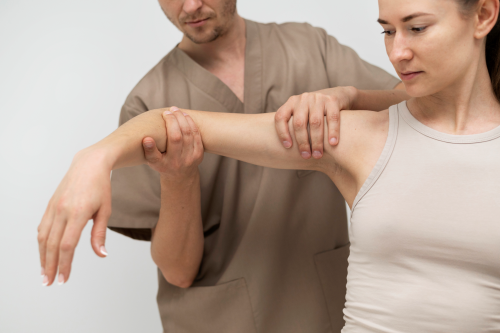
As far as exercises, it is important to do passive range of motion. Self passive range of motion exercises can be viewed at www.stroke-rehab.com/passive-range-of-motion.html. The main precaution is to be careful with overhead range of motion and only move the shoulder in a pain-free range. If the patient is unable to do passive range, the caregiver can do it. Examples of a caregiver doing passive range of motion can be viewed on video at www.stroke-rehab.com/stroke-rehab-exercises.html under the passive range of motion paragraph.
Other exercises that should be performed involve weight bearing and facilitation. Weight bearing can be done by the caregiver placing the patient's open hand on a flat surface (i.e. mat, bed, book), supporting the patient's elbow so the arm won't buckle, and having the patient lean and put weight down through the flaccid arm and hand. One can also tap the muscles to try an initiate movement. To help bend the arm, you can tap the biceps. To help straighten the arm, the triceps can be tapped. To help straighten the knee, tap the quadriceps. Weight bearing can also be practiced through the leg, but it is best to establish sitting balance first and have a physical therapist help with weight bearing through the leg to prevent the patient from falling. If the patient is unable to stand and weight bear even with the help of a therapist, a hi-lo mat can be used to start weight bearing. I often will have the patient sit on the edge of a high-lo mat that is raised with the patient's feet on the floor. Raising the mat and having the patient reaching forward allows for increased weight bearing through the legs, but this is an activity that should be done with the therapist.
Comments for
|
||
|
||
Question: Will Isotoner help to reduce dependent edema in flaccid fingers of flaccid arm?
Answer: There are Isotoner therapeutic gloves that can help with swelling. Wearing of the glove can be combined with elevating the hand above the heart, and retrograde massage (stroking from the fingertips moving toward the wrist). If movement begins to return to the flaccid hand, it is important to start trying to open and close the hand and use the hand to help decrease edema.
There are some medical conditions that aren't appropriate or require close monitoring when dealing with edema management so it's important to check with your physician prior to initiating the use of edema control garments or techniques. Some examples of these medical conditions may include congestive heart failure (or other cardiac conditions with potential for volume overload), severe peripheral vascular disease, blood clots, infection, kidney disorders, and skin disorders.
Question: My husband had a stroke a little over a month ago. It was a left MCA stroke. His right shoulder is subluxed and the arm is flaccid. He has some movement of the right leg i.e can move it sideways towards the left, and if supported, he can kick the leg out.
In therapy, they work only on his left side. Stretching, strengthening etc.
When do they start to work on the right side? It seems to me that he has some potential to regain use of the right leg and perhaps be able to walk with a walker in the future. But, if it is neglected now, wont it just atrophy and become useless?
He is only 61 years old.
Answer: I would definitely ask the therapist(s) who are working with your husband what is being done to address the right side and why they are focusing more on the left side. Sometimes therapists may appear to be working only on the strong side and actually be addressing the weak side. An example of this would be trying to weight bear on the weak leg, while lifting the strong leg. The purpose of this exercise isn't the moving of the strong leg but to strengthen the weak leg to be able to take weight and get the stroke patient to put weight on the weak side.
The same is true for the arm. The therapist may have the patient sit on a mat and have the patient lean on the weak arm while reaching with the strong arm. It appears that the therapist is working on moving the strong arm, but in reality, he or she is working on the patient taking weight through the weak arm and on sitting balance while reaching. If these are the scenarios that you are seeing, then the therapists aren't actually neglecting the weak side. However, I would say that in addition to weight bearing, the therapists should be trying to facilitate movement on the weak side.
If none of the above activities appear to be what the therapists are doing, and exercises are strictly being done with the strong side, then you should definitely express your concerns to the therapist(s). Make sure the therapists working with your husband have experience in working with stroke patients. If your husband's weak side is truly being ignored and your concerns are disregarded by the therapist, then you should consider finding a different therapist. If you're husband is in inpatient therapy and will be moving eventually to outpatient or home therapy, then it's a good time now to research or look for good therapists in your area who come with recommendations from others.
(Kent England)
Question My husband had a stroke on the 6th March 2011. He still has no movement in his left arm and left leg. What exercises can he do at home to improve this? He is currently having physio twice a week at the moment.
Answer: The return of motor function depends on the severity of stroke. There is no way to know for sure if muscle function will return, but the exercises that I use for facilitating movement are:
1) Weight-bearing activities to the arms and legs with the assist of a therapist
2) Electrical Stimulation (only if approved by the patient's physician and there is no contraindications for the patient)
3) Facilitation techniques - i.e. such as quick stretch and tapping of muscles to facilitate movement
You can also try robotic assisted therapy which can be found in some therapy clinics (i.e. Hand Mentor, Foot Mentor, Amadeo, Pablo, etc.)
I'm sure your physiotherapists are doing everything they can to help. Good luck!
by Tauqeer Ahmed
(Pakistan)
Question: My question is my left shoulder had pain my arm is not moving up &down and my left leg is not so balanced. What is your answer?
Hi Tauqeer. I address these issues in the questions above and on the following pages of my website so please review them for the answers to your question:
www.stroke-rehab.com/hemiplegia
www.stroke-rehab.com/passive-range-of-motion.html
www.stroke-rehab.com/balance-exercises.html
Question: My mothers stroke has left her left side partly paralyzed. She can move her left arm somewhat, but cannot move her left leg. Also has a problem with balance and cannot sit up by herself What therapy or exercises could help her.
Answer: I've added your question to this page so that you can see the answers above. Hopefully that will help.
Question: I have a patient of left side hemiplegia.After 12 days of CVA he till persist in flaccid stage. This stage may remain for how much longer?
Answer: Unfortunately, I cannot answer your question. Some people stay in the flaccid stage for only a few days and others have flaccidity for months. At some point, most stroke patients will begin to develop tone in their arm. Sometimes functional movement will be regained and sometimes tone and spasticity can set in without the presence of functional movement. Only time will tell.
by amrit sharma
Question Patient is 55yr old and suffering with right side hemorrhagic stroke. Four months have been passed and there is no tone in left arm. Tone is only present when pain stimulus is given....so kindly suggest solution for it.
Answer I try to elicit contractions by tapping muscles while simultaneously trying to get the patient to move (e.g. I tap the biceps and ask them to try and bend the arm). I also use e-stim to facilitate muscles if the patient is a candidate for using e-stim. Other techniques I use is weightbearing through the arms/elbows and also trying to elicit movements in various positions. Lying on the back tends to increase extensor tone or straightening of the arm and lying on the stomach tends to increase flexor tone of the arm. Some of the first movements I see from many stroke patients is elbow extension by lying them on their backs, supporting the shoulder at 90 degrees of flexion and then tapping the triceps to elicit elbow extension or straightening. This works with many of my patients.